Don’t you love discovering places that offer more than you expected? Our visit to the Painted Desert and Petrified Forest in northeastern Arizona certainly fit that description. We knew we would see colorful desert landscapes and ancient trees turned to stone, but we were about to discover that this fascinating destination held other surprises.
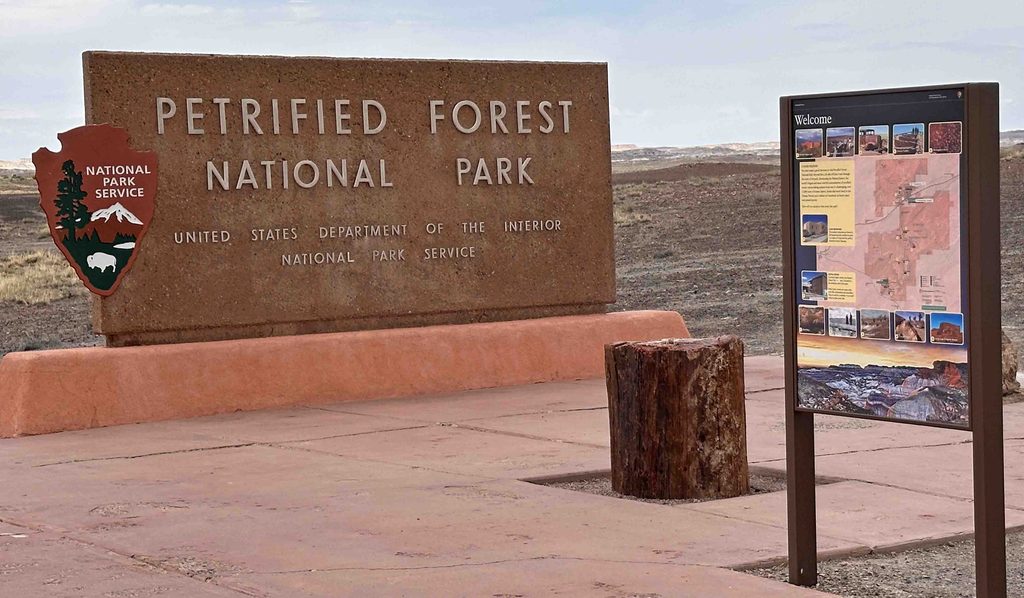
While these two attractions sound like separate destinations, they are actually part of Petrified Forest National Park. That meant we could explore both landscapes with a single admission. Who doesn’t enjoy getting two attractions for the price of one?
Of course, I had recently purchased a Lifetime Senior Pass for the national parks, so our bargain hunting was no longer quite as important. Still, for travelers paying individual park admission fees, experiencing such different landscapes with one entrance fee is a nice bonus.
Little did we know that our day would stretch far beyond colorful hills and fossilized trees. We would also find connections to America’s Mother Road, fascinating prehistoric creatures, and evidence of people who called this region home long before modern travelers arrived.
A Desert That Looks Like an Artist's Palette
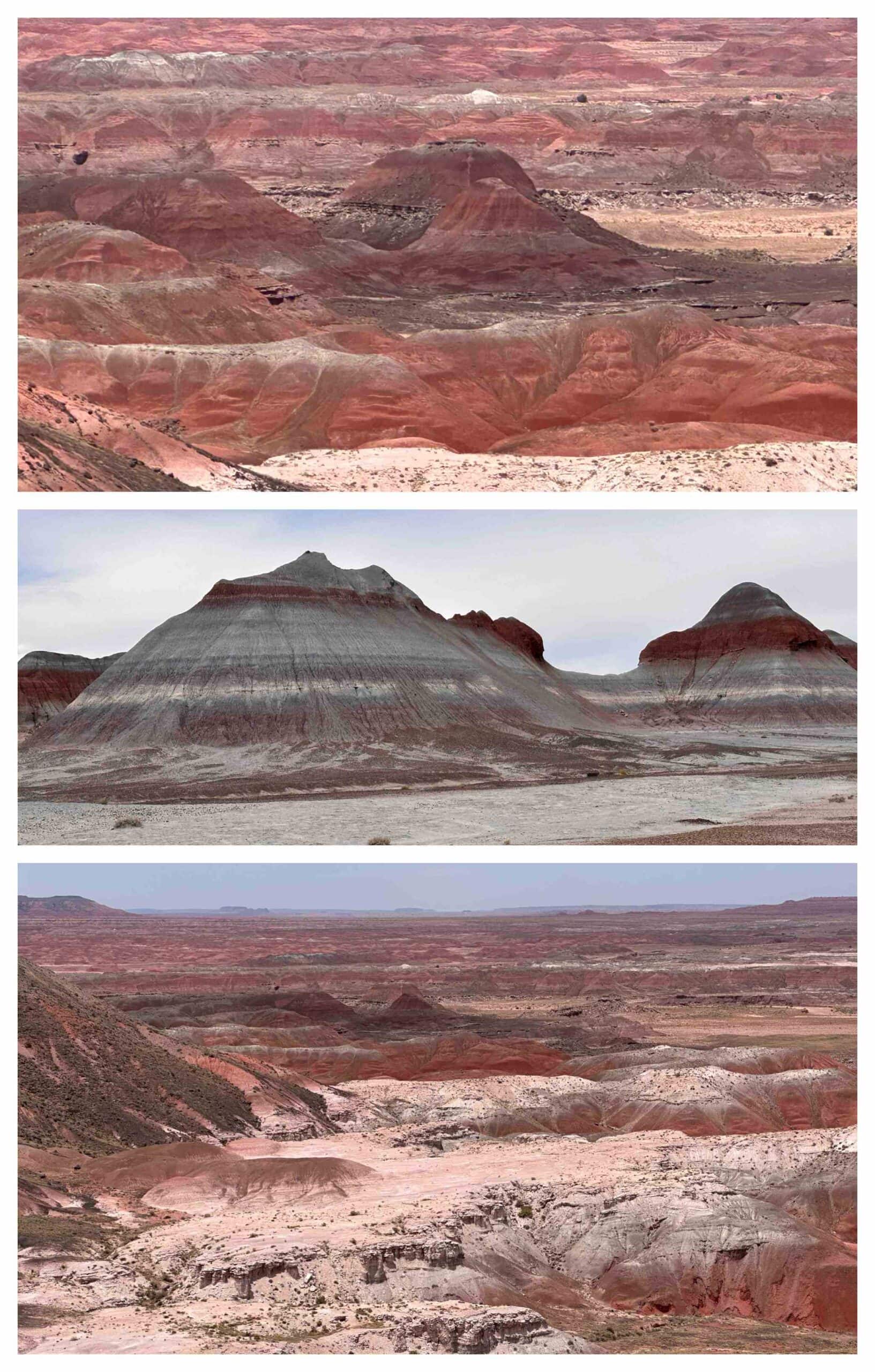
Approaching from the east entrance, we first encountered the Painted Desert. There’s something mesmerizing about landscapes that display layers of color. As we made our way through the park, the sweeping views revealed hills striped with shades of red, orange, pink, and purple. The colors appeared to flow across the landscape, with each new viewpoint offering another perspective.
We immediately began making comparisons to places we had explored on earlier adventures. Badlands National Park in South Dakota came to mind, along with Little Jerusalem Badlands State Park in western Kansas. Both feature unusual formations created by millions of years of geological processes.
While each destination has its own personality, they both help us appreciate the extraordinary artwork nature creates.
The colors of the Painted Desert are more than just beautiful scenery. They provide clues to the region’s ancient environment. Much of the landscape consists of sedimentary rocks deposited during the Late Triassic Period more than 200 million years ago.
The colorful layers developed as minerals within ancient sediments reacted to different environmental conditions. Iron exposed to oxygen produced reddish hues, while lower-oxygen conditions helped create greenish and bluish shades. Over millions of years, erosion uncovered these layers, producing the dramatic formations visitors enjoy today.
Finding the Mother Road in the Desert
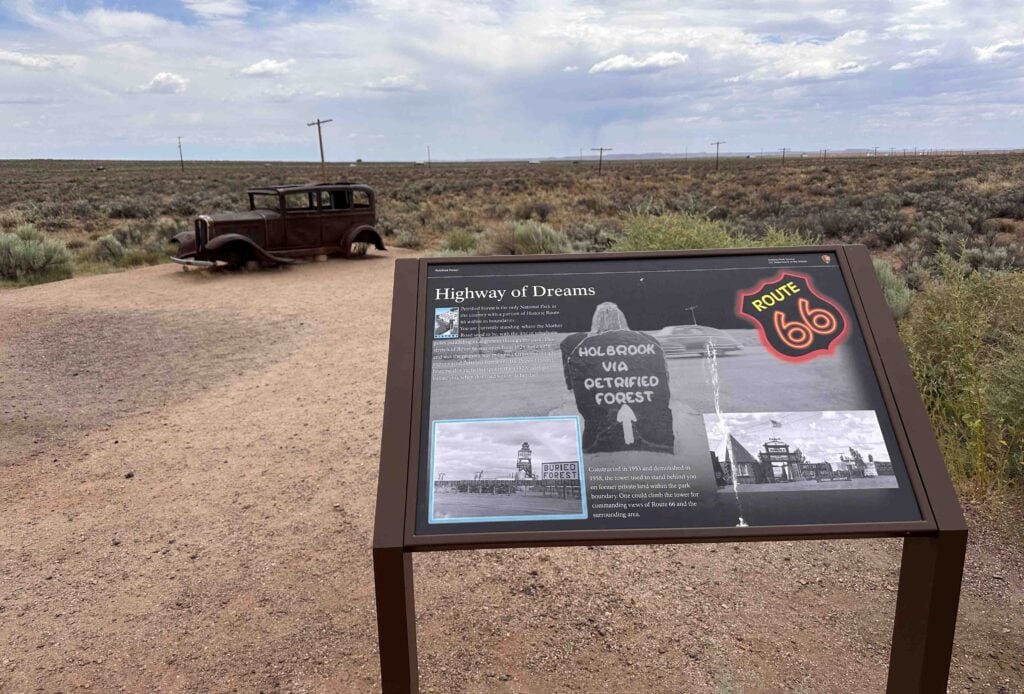
Our Arizona travels were partly focused on exploring historic Route 66. We were following sections of the Mother Road through New Mexico and Arizona. Knowing the highway once passed through Petrified Forest National Park made this a must-do on our itinerary. Established in 1926, Route 66 became a symbol of American automobile travel. Families headed west in search of opportunity, while vacationers later embraced the freedom of exploring the country by car.
The national park holds a particularly interesting distinction. It is the only national park in the United States containing a section of the original Route 66 corridor. Although vehicles no longer travel this historic alignment, visitors can still find evidence of the old highway. Weathered telephone poles and traces of the original roadbed mark its course. A rusted 1932 Studebaker stands near the former route, providing a fitting reminder of the automobiles that once traveled this stretch of Arizona.
When an Ancient Forest Turns to Stone
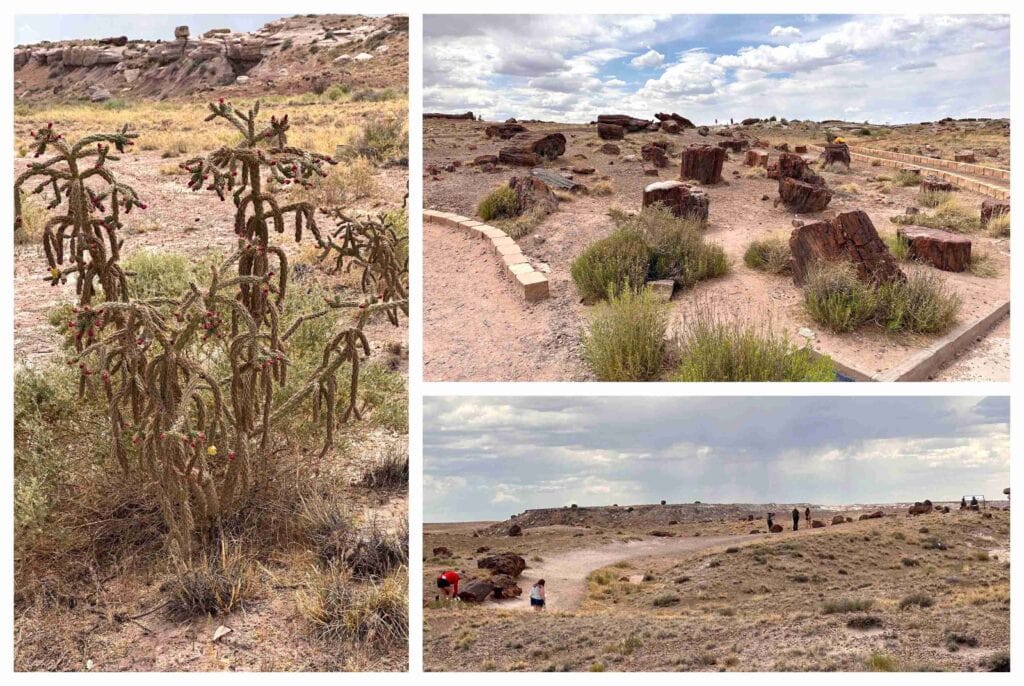
As we went farther into the park, the scenery began to reveal another remarkable chapter of Arizona’s past. The Painted Desert and Petrified Forest offer entirely different visual experiences, but their geological stories are closely connected. We were surprised at the sheer volume of petrified wood scattered throughout the landscape. It seemed that everywhere we looked, another collection of ancient tree fragments appeared. Some resembled enormous fallen logs, while others looked like sections of trunks that someone had carefully cut into pieces.
The concentration of these remnants was astonishing. To understand how this extraordinary landscape developed, we have to travel back approximately 200 million years. The arid terrain we saw was once lush, with rivers, floodplains, and forests. Forests grew near waterways and supported a variety of prehistoric animals.
When trees fell, rivers carried some trunks into channels, where they became buried beneath sediment. Over time, groundwater carried dissolved minerals into the buried wood. Silica gradually crystallized, turning microscopic details of the original trees into quartz. Geological uplift and erosion eventually exposed these ancient remnants.
The results are now scattered across the landscape, allowing visitors a chance to examine pieces of a forest that existed long before humans walked the Earth.
Getting Up Close to Trees That Became Stone
Seeing petrified logs from the roadway was impressive, but we wanted a closer look. We got that chance at the Rainbow Forest Museum near the southern entrance.
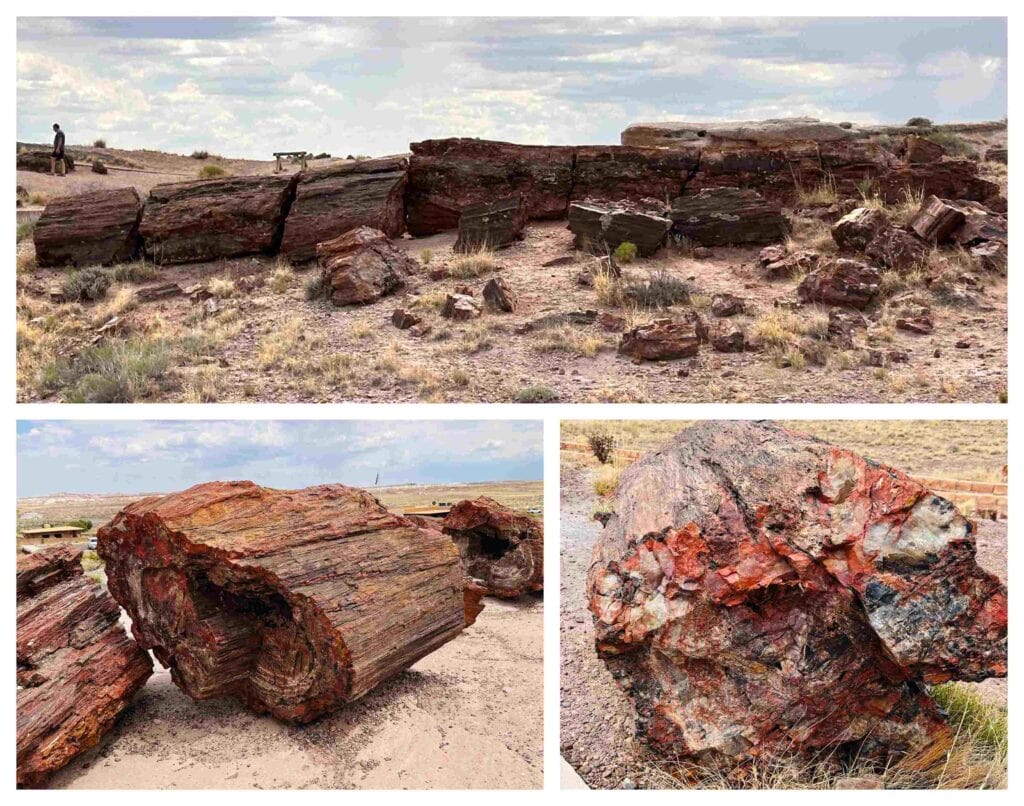
After parking, we headed to the Giant Logs Trail, which begins behind the museum. This paved loop stretches about a half-mile and passes some of the largest petrified logs in the park. One of its most impressive specimens is appropriately named Old Faithful, a massive petrified log measuring nearly ten feet across at its base.
What originally looked like ordinary brownish rocks revealed fascinating patterns and mineral deposits. Deep reds, golden yellows, creamy whites, and darker colors create an almost otherworldly appearance. Sometimes it was difficult to believe what our eyes were seeing. These were clearly stone formations, yet their shapes and textures still suggested the trees they had once been.
We learned that the color variations came from trace minerals within the quartz. Iron compounds contributed reds and yellows, while manganese helped produce darker colors and shades of purple. In some places, mineral crystals formed within cracks and cavities, adding another level of detail. The logs also displayed remarkably clean breaks, almost as though someone had sliced through them. Their quartz composition makes them brittle, and forces have fractured the trunks over time.
Dinosaurs, Ancient People, and Unexpected Discoveries
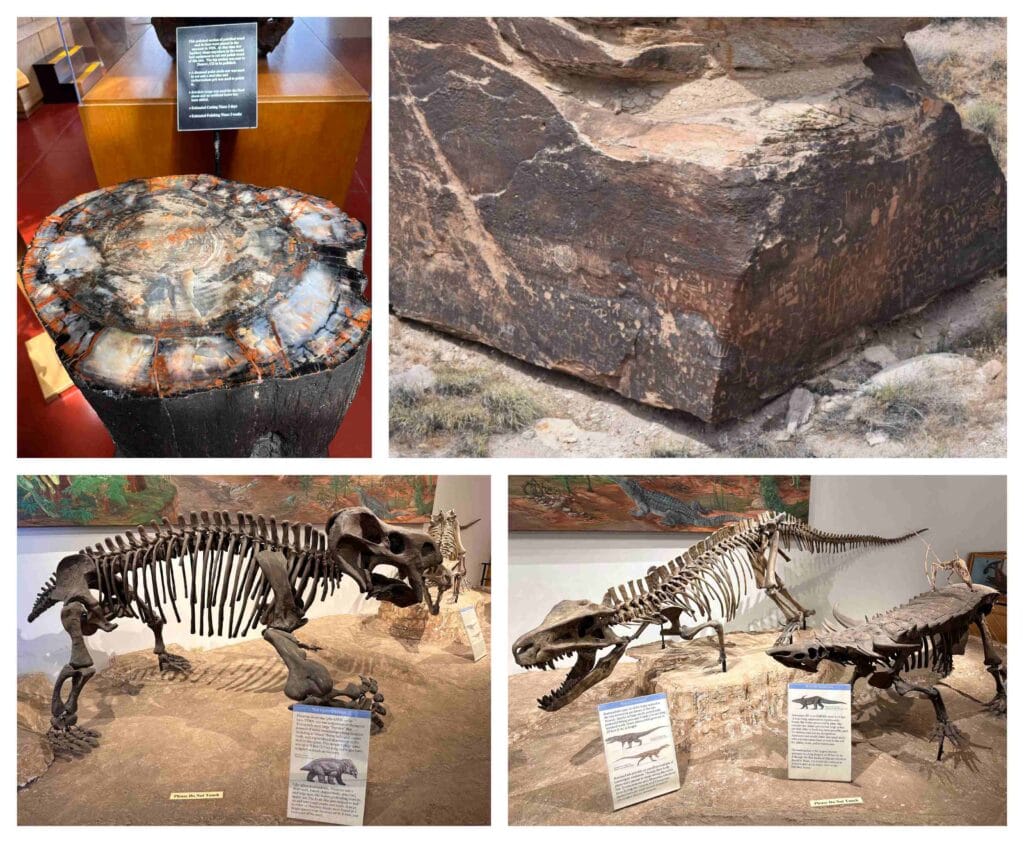
After exploring the trail, we visited the Rainbow Forest Museum to learn more about the remarkable landscape surrounding us. I was pleasantly surprised to discover exhibits featuring the skeletons of prehistoric creatures that once inhabited this region. We have always enjoyed learning about dinosaurs, particularly learning how different species have been discovered across North America.
Not all the creatures on display were dinosaurs. During the Late Triassic, this region was home to enormous amphibians and other reptiles. Early dinosaurs were present, but they were not yet dominating. Fossils of early dinosaurs have been discovered within the park. The museum also features reconstructed skeletons and casts based on actual fossil discoveries.
Our museum visit also provided more information about another fascinating aspect of the Painted Desert and Petrified Forest: the people who lived in this region long before Europeans arrived. During our drive, we encountered petroglyphs etched into rock surfaces. Seeing these markings naturally raised questions about the people who created them and what they were trying to communicate.
At Newspaper Rock, one of the park’s best-known archaeological sites, more than 650 petroglyphs cover a collection of rock faces—some date back approximately 2,000 years. Ancestral Puebloan people created many of them as they lived, farmed, and hunted along the Puerco River. The nearby Puerco Pueblo settlement provided additional evidence of the communities that occupied the region.

Why the Painted Desert and Petrified Forest Deserve a Spot on Your Itinerary
By the end of our visit, we were glad we set aside time for this remarkable national park. What began as an opportunity to admire colorful desert scenery became an exploration of prehistoric forests, ancient animals, historic Route 66, and Indigenous cultures. Few destinations offer such a fascinating combination within one relatively compact area.
For travelers planning their own visit, here are a few helpful details.
Planning Your Visit
Location: Petrified Forest National Park lies in northeastern Arizona, near Holbrook and Interstate 40.
Entrances: The northern entrance is off I-40 at Exit 311. The southern entrance connects to US Highway 180. Visitors can enter from either direction.
Admission: Standard entrance is $25 per private vehicle, valid for seven days. America the Beautiful passes, including the Senior Lifetime Pass, are accepted.
Operating hours: The park generally opens from 8 a.m. to 5 p.m. Arizona operates on Mountain Standard Time year-round. The park is closed on Thanksgiving and Christmas.
Scenic drive: The main park road is about 28 miles and connects the northern and southern entrances.
Time needed: Allow at least three hours for the scenic drive and several stops. It can easily turn into half a day, or longer if you plan to explore trails and museums.
Visitor facilities: The Painted Desert Visitor Center is near the northern entrance, while Rainbow Forest Museum is near the southern end. Both offer restrooms and visitor information.