
Have you ever visited a place because of a personal connection to its history? That was our primary reason for adding Salem, Massachusetts, to our road trip. While most visitors associate this coastal New England city with witches and Halloween, I had a different destination in mind. I wanted to visit the grave of George Jacobs Sr., one of my ancestors who was executed during the infamous Salem Witch Trials of 1692.
I’ve always enjoyed digging into family history, especially when it connects to significant events in America’s past. I already knew George’s story, but reading about an ancestor and visiting a place connected to his life are two very different experiences. Our stop in Salem let me connect the historical records with a place that played a role in his story.
Our visit coincided with Salem’s 400th anniversary year. Founded in 1626, the city celebrated four centuries of history, though its most famous chapter came in 1692. The Salem Witch Trials would forever shape the community’s identity and eventually help transform it into one of New England’s most recognizable tourist destinations.
We arrived on a Sunday, which we often reserve for covering longer distances during our extended road trips. An unexpected fall nor’easter was finally winding down, leaving behind damp conditions that weren’t nearly as bad as we had feared. With the worst of the weather behind us, we decided to explore modern Salem before heading to the historical site that had brought us here.
Modern Salem: Where Witchcraft Meets Tourism
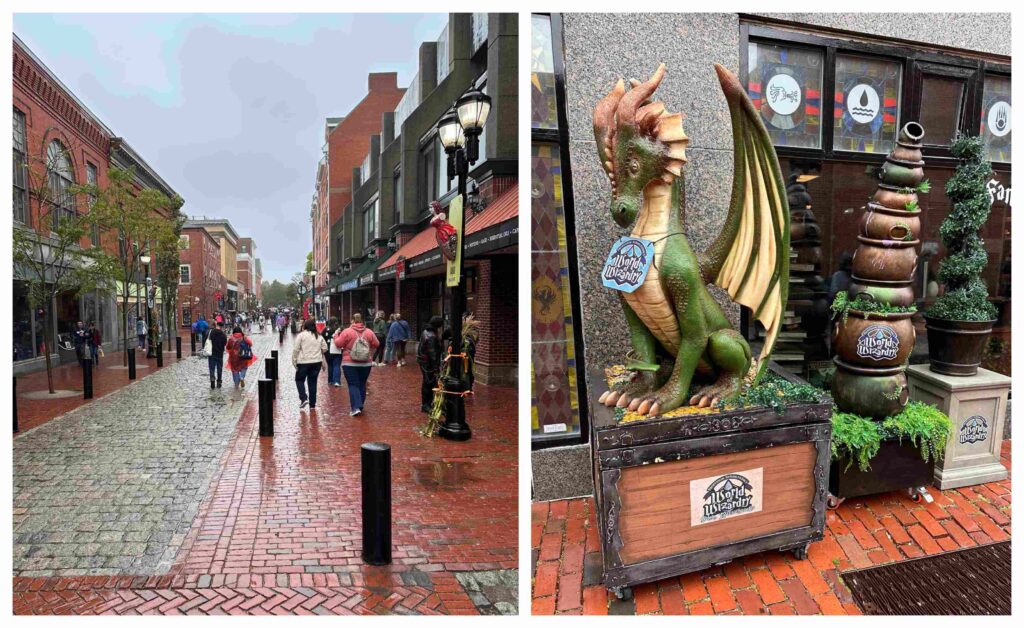
It didn’t take long to realize that Salem has fully embraced its reputation as the Witch City. Our exploration took us to the Essex Street Pedestrian Mall, a downtown shopping district where witch-themed businesses seem to be everywhere. The lingering nor’easter appeared to be working in our favor. While Salem can draw enormous crowds in the fall, the damp weather had thinned the visitors considerably. We could enjoy the downtown atmosphere without the shoulder-to-shoulder crowds this popular destination often draws. Apparently, witches prefer to stay dry!
We walked the length of the pedestrian mall without finding a single shop that tempted us inside. The witch-themed merchandise certainly fits Salem’s modern identity, but it wasn’t quite our style. Still, the experience offered an interesting glimpse into how the city has transformed its historical reputation into a thriving tourism industry.
Of course, there’s quite a contrast between today’s playful interpretation of witchcraft and the events that made Salem famous. The people accused in 1692 weren’t the mystical characters celebrated in modern shops. They were ordinary members of their communities who became caught up in a wave of fear and suspicion, often with tragic consequences.
With our downtown exploration complete, we turned our attention to the historical side of Salem’s story. That meant heading to nearby Danvers and the Rebecca Nurse Homestead, where we’d find a much more personal connection to the events of 1692.
Origins of the Salem Witch Trials
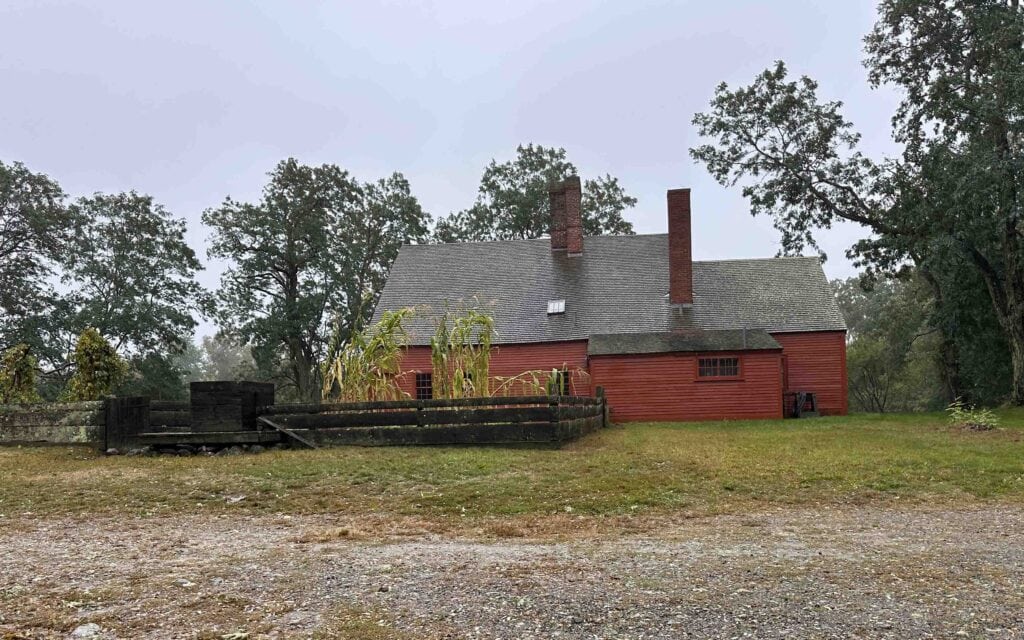
Leaving the witch-themed shops of downtown Salem behind, we made our way to the Rebecca Nurse Homestead in nearby Danvers, Massachusetts. While the name of Salem is forever linked to the witch trials, many of the events actually occurred in what was then known as Salem Village. That community eventually became Danvers, making it an important destination for anyone interested in the history of 1692.
The homestead dates to 1678, when Rebecca and her husband, Francis Nurse, moved onto the property. The family farm originally encompassed around 300 acres, and their home remains one of the few surviving structures directly connected to the trials. Today, the historic property offers visitors an opportunity to explore a place where some of that history actually unfolded.
Rebecca Nurse was 71 years old when she was accused of witchcraft in March 1692. A respected member of the community, she seemed an unlikely suspect. Yet the accusations were spreading quickly, fueled by religious fears, neighborhood disputes, and a growing belief that the devil was working among the colonists. In a society where witchcraft was considered a genuine threat, even an accusation could have devastating consequences.
What makes Rebecca’s story particularly disturbing is that her neighbors and family members came forward to defend her. A jury initially found her not guilty, but the judges ordered them to reconsider. The verdict was reversed, and Rebecca was executed on July 19, 1692. Her experience demonstrates just how far the hysteria had progressed. Even a respected elderly woman, supported by members of her community, wasn’t safe from suspicion.
During our visit, I spoke briefly with a museum staff member about my search for George Jacobs Sr.’s grave. The conversation led to directions for a small burial ground toward the back of the property. With those directions in mind, I headed off to find a piece of my own family’s history.
The Story of George Jacobs Sr.
Following the museum staff member’s directions, I made my way toward the small burial ground at the back of the Rebecca Nurse Homestead. The walk followed a fence line bordered by trees. The lingering dampness from the nor’easter had muted the foliage, but it was still a pleasant reminder that we were exploring New England at the start of one of its most colorful seasons.
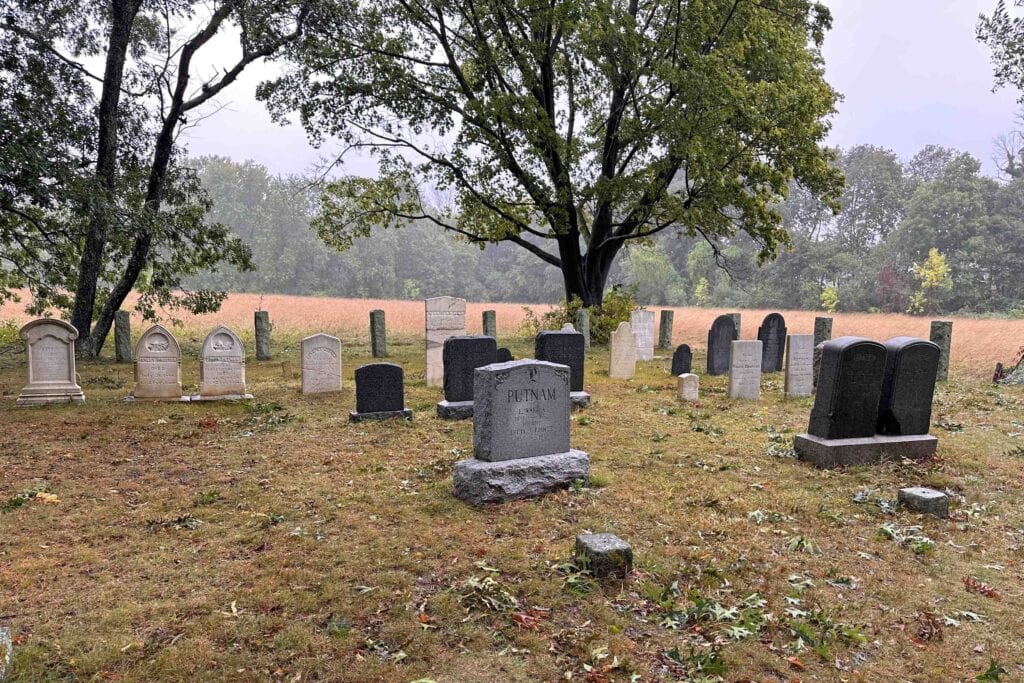
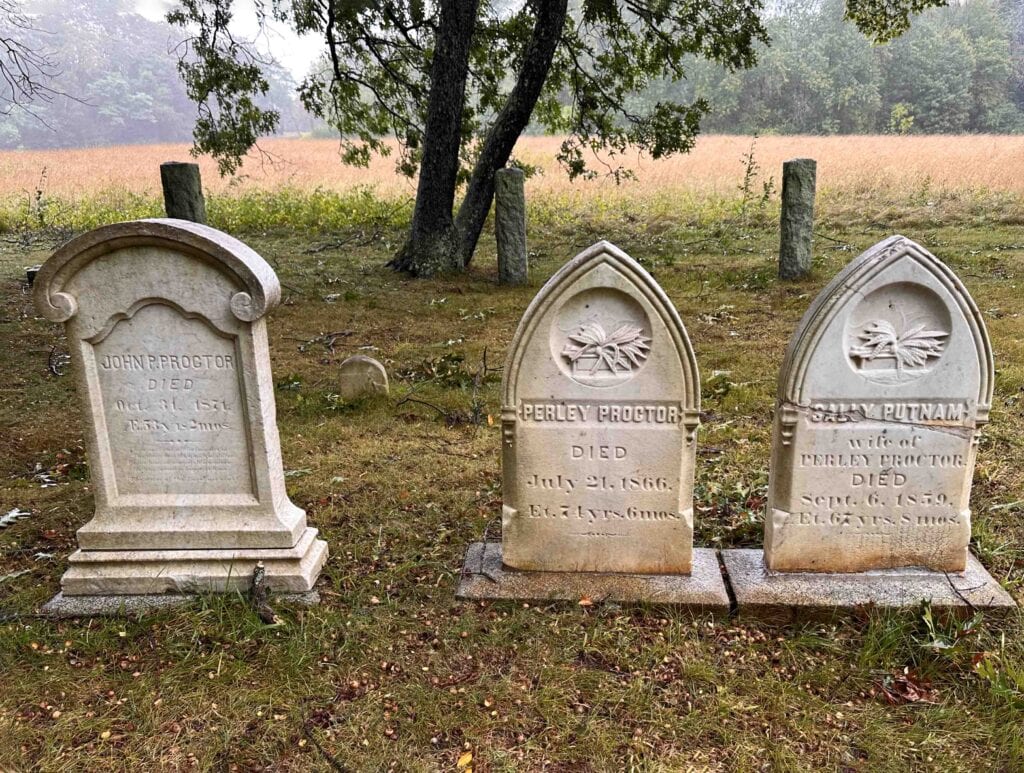
The cemetery contains graves of members of the Nurse and Putnam families, along with memorials connected to the Salem Witch Trials. Some names were immediately familiar, including John Proctor and members of the Putnam family. Their lives had become part of one of America’s most infamous historical events.
By the time the trials ended, more than 200 people had been accused of witchcraft, and 20 had been executed. Much of the evidence rested on claims of supernatural attacks that were impossible to disprove. In an atmosphere of fear and suspicion, even respected community members found themselves in danger.
Among the accused was my ancestor, George Jacobs Sr., an elderly Salem farmer who walked with the assistance of two staffs. Arrested in May 1692, he faced accusations of tormenting others through witchcraft. Even family members became entangled in the proceedings.
One detail from his story had always intrigued me. I had heard that George was accused because he could quote scripture despite being unable to read. The surviving court records tell a somewhat different story. When questioned about family prayers, George acknowledged that he couldn’t read. The magistrates then demanded that he recite the Lord’s Prayer, which he struggled to complete correctly. In that atmosphere of suspicion, even this became grounds for further questioning.
George maintained his innocence, but his protests did little to change the outcome. On August 19, 1692, he was hanged alongside four other men convicted of witchcraft. Knowing this history made my search through the burial ground especially meaningful. Somewhere among the markers was the grave of the ancestor whose story had brought me to Salem in the first place.
Finding George Jacobs Sr.'s Grave
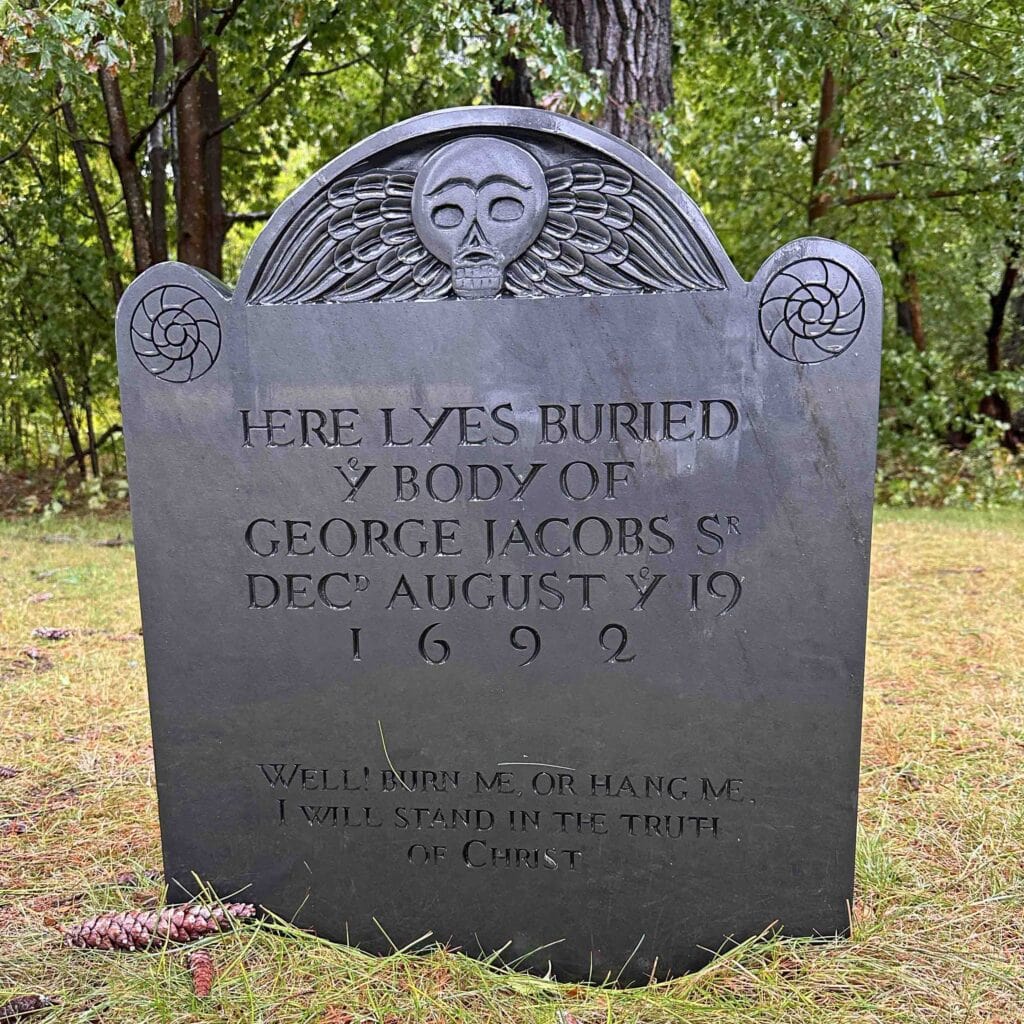
After exploring the small burial ground, I located the grave of George Jacobs Sr. His headstone stood out from many of the others, with its darker stone and noticeably newer appearance. That difference made sense. Although George had been executed more than three centuries earlier, his presumed remains had only been buried at the Rebecca Nurse Homestead in 1992.
As it turns out, George’s remains had quite a journey of their own. Family tradition holds that relatives recovered his body following his execution and secretly buried him on his Salem farm. In 1864, a skeleton believed to be his was discovered on the former property and subsequently reburied. The remains were uncovered again during development in the 1950s, beginning another chapter in this unusual story.
For decades, the bones were kept in storage before finally being reinterred at the Rebecca Nurse Homestead on the 300th anniversary of the Salem Witch Trials. Although their identity cannot be established with absolute certainty, the remains are believed to belong to George Jacobs Sr. His newer headstone, designed in an older style, now marks what may be the only known grave of a person executed during the trials.
Standing before the marker brought my family-history research full circle. I’d known George’s story long before we arrived in Salem, but visiting his final resting place added a personal connection that no amount of reading could provide. Seeing his name carved into the stone was a reminder that the people involved in these historical events weren’t simply names in old records. They were real people whose lives and families were forever changed.
Our visit to Salem reinforced something we’ve come to appreciate during our travels. While famous attractions may draw us to a destination, it’s often the historical connections and lesser-known places that create the most memorable experiences. Sometimes the best discoveries are waiting just a short distance from the usual tourist trail.
Have you ever discovered a historical place that made a road trip especially memorable? We’d love to hear about the unexpected stories and connections you’ve uncovered during your own travels.